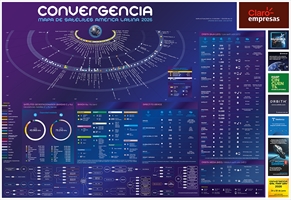
Satellite Map in Latin America 2026 - Credit: © 2026 Convergencialatina
While the geostationary satellite business continues its consolidation process, LEO constellations are expanding in scale, and the Direct-to-Device (D2D) market is beginning to move beyond the experimental stage and into a phase of commercial execution.
In the GEO segment, SES’s acquisition of Intelsat has altered the competitive landscape and further consolidated a market that has been undergoing concentration for years, as illustrated by Viasat’s acquisition of Inmarsat. As a result of this integration, SES now controls more than 50 satellites covering Latin America, becoming the dominant player within a regional fleet that totals 71 satellites operating in C- and Ku-bands, in addition to 24 spacecraft providing Ka-band capacity.
The traditional geostationary business is also facing the cancellation of previously announced satellite projects—such as Intelsat 41 and Intelsat 42, originally scheduled for launch in 2028—as well as declining revenues compared to the rapidly growing LEO segment.
The sustained expansion of LEO fleets continues to be led by Starlink, which reached 10.3 million active satellite broadband subscribers worldwide as of March 2026. Meanwhile, the market is preparing for the start of commercial services from Amazon LEO, which already has approximately 239 satellites in orbit as part of a planned constellation of more than 3,200 spacecraft.
Growth is also extending into medium-Earth orbit (MEO). SES continues to expand its O3b mPower constellation, which currently comprises 10 operational satellites and is expected to add more spacecraft during 2026. At the same time, the company is developing meoSphere, a future 28-satellite constellation scheduled to enter service by the end of the decade.
The main addition to Satellite Map in Latin America is a dedicated section focused on Direct-to-Device services. This segment is no longer limited to emergency communications but is increasingly being positioned as a scalable connectivity solution for smartphones, IoT devices, and industrial applications.
Amid this momentum, D2D players are strengthening their positions through acquisitions, strategic partnerships, and spectrum access. SpaceX continues to expand Starlink Mobile, a network currently supported by 650 first-generation satellites while planning a second-generation fleet. AST SpaceMobile is accelerating deployment of its BlueBird constellation, while Lynk is awaiting completion of its merger with Omnispace after securing strategic investment and support from SES. Another key development was Amazon’s acquisition of Globalstar, announced in April 2026 for more than US$11 billion.
As for D2D adoption in Latin America, Entel in Chile and Peru has emerged as the pioneering mobile operator, working with Starlink’s first-generation Direct-to-Cell satellites. Liberty Latin America has also announced trials and upcoming launches in Jamaica, Panama, and Costa Rica. Meanwhile, AST SpaceMobile has secured strategic regional agreements with Telefónica, América Móvil, and Millicom.