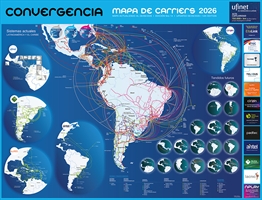
Carriers Map in Latin America 2026 - Credit: © 2026 Convergencialatina
The expansion of Data Centers and, particularly, the new processing demands associated with AI remain key drivers of decisions regarding digital infrastructure in Latin America. In 2026, resilience, route diversity and the ability to keep the main digital hubs connected even in the event of failures or disruptions have emerged as central factors, beyond simply increasing capacity.
In this scenario, the expansion of terrestrial corridors is gaining relevance as a complement and alternative to submarine routes. One example is the agreement between Sparkle and Entel Bolivia to commercialize a new low-latency route between Peru and Brazil, crossing Bolivia as part of the Bioceanic Corridor. The goal is to offer an alternative to existing submarine routes and add a terrestrial link between the Pacific and Atlantic oceans.
Cirion has more than 105,000 kilometers of fiber deployed across more than 20 countries, combining approximately 50,000 kilometers of submarine network with more than 32,000 kilometers of long-haul terrestrial network and around 22,000 kilometers of metropolitan networks. The company launched a Network-as-a-Service platform aimed at making this infrastructure programmable, providing greater adaptability and automation to meet the needs of enterprises, carriers, hyperscalers and AI workloads.
Resilience is also reflected in the submarine map. The region continues to add new routes and landing points, but with an approach aimed at reducing dependence on single corridors. In August 2026, Google announced three new submarine systems —Alisios, Canoa and OlaLuz— that will connect the Dominican Republic with Panama, Chile, Bermuda and Florida, as well as a new branch of Firmina. The Americas Connect project explicitly aims to build a more resilient network linking North America, Central America, the Caribbean and South America.
The Caribbean is thus emerging as one of the areas where this reconfiguration is most clearly visible. The Dominican Republic is gaining importance as an interconnection hub, while Panama maintains its strategic position within the new corridors. The projects developed by Trans Americas Fiber —TAM-1—, Liberty, Sparkle and Gold Data —Manta—, and Telconet —Carnival Submarine Network (CSN)— are part of this trend. So are the CELIA cable —an initiative involving Telxius, Setar, Orange and APUA— and Tikal —by Telxius and América Móvil—.
Liberty and Cantv, meanwhile, plan to deploy the Fenix cable, which will connect Venezuela to the Curaçao hub and, from there, to Liberty Networks' submarine systems —Arcos, EC-Link, Jerry Newton and PCCS—, providing route diversity, high availability and resilience.
Brazil is also further strengthening its position as a regional platform. V.tal combines approximately 26,000 kilometers of submarine cables with around 450,000 kilometers of terrestrial fiber, integrating connectivity, Internet Exchange Points and Data Centers. In this context, the 280-kilometer extension of the Malbec cable to Porto Alegre, scheduled for 2027, will bring southern Brazil into the international network and position the city as a new digital hub for the Southern Cone, with a projected capacity of up to 20 Tbps per fiber pair.
At the same time, Data Centers are no longer isolated points and are becoming nodes within a regional architecture. The integration of long-haul networks, metropolitan networks, landing stations and carrier-neutral Data Centers is gaining importance as demands for low latency, availability and capacity continue to grow. In this regard, Cirion reaches approximately 200 interconnected Data Centers, while other wholesale players are expanding their footprint with their own facilities: among them, Ufinet operates 21 centers across the region, while Antel will add a new facility to its Pando site dedicated to AI workloads, with an investment of US$70 million.